News

With a new method that could be extended to study Earth’s core and nuclear fusion, they identify and explain jumps in the electrical conductivity of aluminum under extreme conditions.
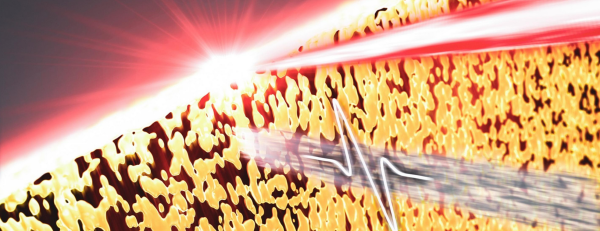
A short laser pulse (red) heats a sheet of aluminum, causing it to melt and break up into droplets. Below, a terahertz pulse (gray) passes through the now molten metal.
  Students from the HEDS division joined SLAC's Holiday Social, recreating the HEDS division in gingerbread form as part of a SLAC-wide competition. 
HEDS students with their completed gingerbread house

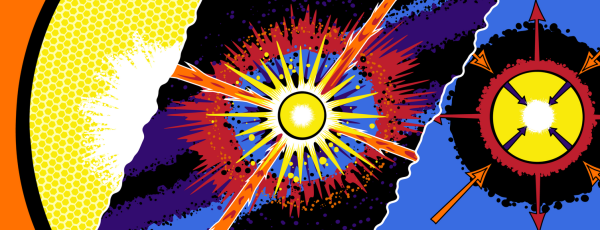
To achieve peak energy output, inertial fusion energy targets must be perfectly symmetrical and perform under extreme temperatures and pressures. Researchers at SLAC are developing experimental techniques to evaluate new target candidates. 

Graphic representation of lasers converging on a single fusion fuel capsule in an inertial fusion energy reaction chamber.
  Arianna Gleason, the deputy director of the HEDS division, was announced as a newly elected Fellow of the Mineralogical Society of America, in recognition of her outstanding contributions to the fields of mineralogy, crystallography, geochemistry, and petrology.
MSA Logo
  PhD student Edna Rebeca Toro Garza won a prize for her poster "Observing the influence of atomic and nanoscale structure on the DC conductivity of warm dense matter" at the 9th Meeting of the Asia-Pacific Conference on Plasma Physics, hosted in Fukuoka, Japan.
AAPPS DPP Logo
The team unexpectedly formed gold hydride in an experiment that could pave the way for studying materials under extreme conditions like those found inside certain planets and stars undergoing nuclear fusion.
Intense pulses from an X-ray free-electron laser heat compressed samples of hydrocarbons to extreme conditions, resulting in the reaction of gold and hydrogen to form gold hydride.
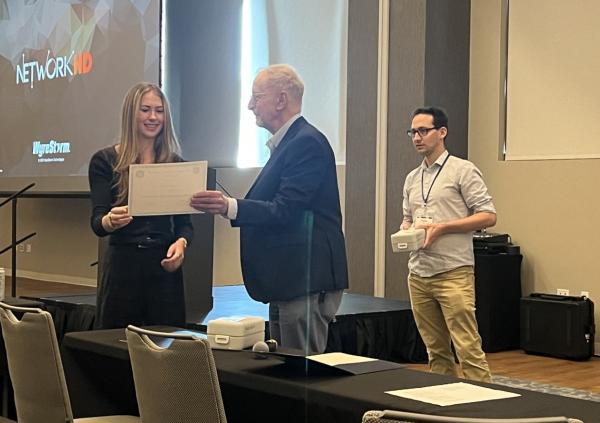
  Carly Chandler, an intern with the HEDS group, was awarded the Best Undergraduate Poster award for her presentation "Theoretical first-principles simulations on the stability and phase transitions of MgO₂ near Earth's mantle conditions" at the Strongly Coupled Coulomb Systems conference, held at Lake Tahoe, NV. Carly is completing a summer internship in the HEDS group through the DOE's SULI program, and is working on simulating material deep inside the Earth with her...
Carly Chandler is awarded her poster prize by organizing committee members David Neilson (U. Antwerp) and Thomas White (UNR)
    At the HEDS Summer School, hosted by UC San Diego, two group members were recognized for their contributions. Maitrayee Ghosh won the best postdoc talk award for her presentation "Probing extreme condition nickel with on-the-fly machine learning molecular dynamics simulations" and Megan Ikeya won a prize for her poster "Investigating Shock Fronts and Interface Effects in IFE Foams".
UCSD Seal
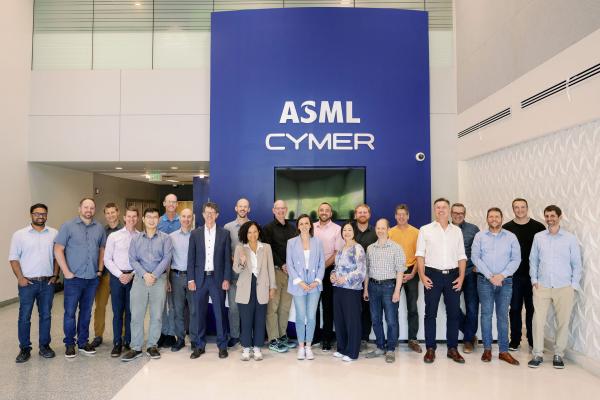
  Stanford professors, including  Prof. Debbie Senesky, Prof. Matthias Kling, and Prof. Siegfried Glenzer, visited ASML in San Diego for a day of workshops, networking and open discussions to identify topics for collaborative research and innovation.
ASML and Stanford staff